← Back to the 60-film index
Published 2026-07-24 Runtime 54:32 Sampled every 60s ASR · not captions
Speakers ask whether greater AI consumption produces useful work. Model comparisons, experimental results and a customer engineering account develop the question before audience discussion qualifies the trade-offs.
Narrative interpretation, grounded in the timed machine transcript and the sampled images below.
Story sequence Editing comparison Timed transcript guide Provenance 01 / STORY SEQUENCE
What the film sets up, shows, and resolves These are exact analytical ranges on the source clock, not frame-accurate cut boundaries. A beat may contain several shots. Images are sampled; no continuous viewing or listening pass is claimed.
Hosts contrast consumption metrics with useful outcomes. Sampled visual. Two hosts, meme, agenda and four-part evaluation slide.
Edit observation. Host-led layout becomes slide-dominant with a speaker inset.
Window 0.000s–420.000s · visual sample 300.500s
Model comparisons lead to developer-use suggestions. Sampled visual. Model cards, scatterplot, illustration grid and settings slide.
Edit observation. One enlarged panda illustration supplements the output matrix.
Window 420.000s–915.000s · visual sample 720.500s
Speaker compares application-level efficiency techniques and reported results. Sampled visual. Feature list followed by browser comparison tables.
Edit observation. Explanatory slides precede sampled experimental result panels.
Window 915.000s–1385.000s · visual sample 1260.500s
Customer guests introduce their marketing platform and engineering remit. Sampled visual. Guest chapter card, portraits and website-workflow slides.
Edit observation. Yellow guest slides replace the earlier laboratory interface.
Window 1385.000s–1740.000s · visual sample 1620.500s
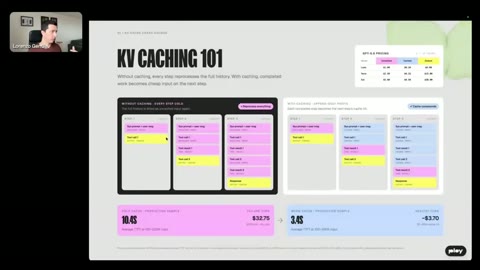
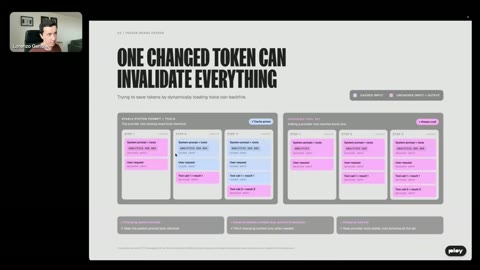
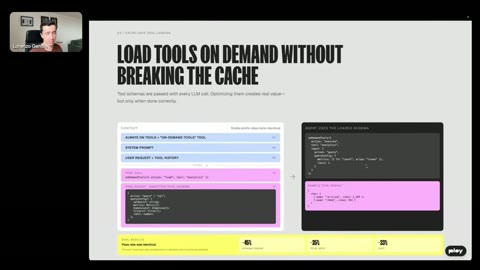
Engineer explains caching, batching and smaller tool outputs. Sampled visual. Colored context diagrams, code blocks and claimed savings.
Edit observation. Repeated column layouts compare retained and invalidated cache states.
Window 1740.000s–2385.000s · visual sample 1860.500s
Questions expose delegation, context and caching trade-offs. Sampled visual. Audience-question cards beside hosts or remote guests.
Edit observation. Persistent question panels accompany changing speaker views.
Window 2385.000s–3200.000s · visual sample 2880.500s
Hosts share resources and announce another session. Sampled visual. Two hosts beside a resource list.
Edit observation. Resource layout replaces the earlier question-card format.
Window 3200.000s–3272.714s · visual sample 3240.500s
02 / SOURCE COMPARISON
One editing mechanism to study 1740.000s–2040.000s · Compare with the original ↗
1800.500s · Source sample, not a measured cut.1860.500s · Source sample, not a measured cut.1920.500s · Source sample, not a measured cut.Observed Colored columns explain reuse, then invalidation; a later diagram adds code.
Interpretation Interpretation: benefit, failure and remedy make the optimization causal.
Try with your own footage Diagram an original workload, perturb one input, then demonstrate a repair.
Do not overread it Reported savings concern the speakers' workloads, not universal performance.
03 / TRANSCRIPT GUIDE
Follow the argument on the source clock This is a paraphrased index, not a verbatim transcript. Full ElevenLabs ASR stays in the local research bundle. No publisher captions are presented here. Links open the official source, rounded down to a whole second; exact returned ASR anchors are listed separately. 9,562 machine-recognized words.Source range Paraphrase + speech anchor 0:00–7:00 ↗ Hosts contrast consumption metrics with useful outcomes.ASR word start 170.100s 7:00–15:15 ↗ Model comparisons lead to developer-use suggestions.ASR word start 580.004s 15:15–23:05 ↗ Speaker compares application-level efficiency techniques and reported results.ASR word start 930.080s 23:05–29:00 ↗ Customer guests introduce their marketing platform and engineering remit.ASR word start 1470.368s 29:00–39:45 ↗ Engineer explains caching, batching and smaller tool outputs.ASR word start 1768.412s 39:45–53:20 ↗ Questions expose delegation, context and caching trade-offs.ASR word start 2500.048s 53:20–54:32 ↗ Hosts share resources and announce another session.ASR word start 3205.440s
04 / EVIDENCE BOUNDARY
What was checked Primary source Official OpenAI channel · jyuyY86GJnA ↗ Acquired 2026-09-17T18:16:42.408866+00:00 · 854 × 480 research rendition Publication basis playerMicroformatRenderer.publishDate · 2026-07-24T12:47:16-07:00 Media SHA-256 a5b954dc4924f6b3d5b90e5791b5681d377f328ea07306d9f0365f1ec6938a18 Transcript ElevenLabs scribe_v2 · ASR unverified · audio-to-source offset 0.000000s. Actual returned timing, not text-length estimates. Visual review 2 contact sheets · Sixty-second samples, three enlarged sampled frames and unverified ASR; no playback review. Case limitation Minute gaps hide execution; ASR contains inconsistent names. The final 32 seconds lack a still sample. Rights Short discussed stills credited to OpenAI. Zero transcript words quoted. Research evidence is not a licensed asset library for new films. ← Navigating AI Transformation in the Legal Industry | Jonathan Williams, Head of France, Legora Building at the pace of AI innovation | Grant Lee, Gamma →